Bharat Tales
Indian mythology retold for children aged 5 to 12 — reverent to the source texts, gentle where the myths are hard, and built to be read aloud at bedtime.
Out now
Bharat Tales · Book One
Six stories from the Shiva Purana, Skanda Purana and the Mahabharata. 32 pages, full colour. Ages 5–12.
Coming very soon
Bharat Tales · Book Two
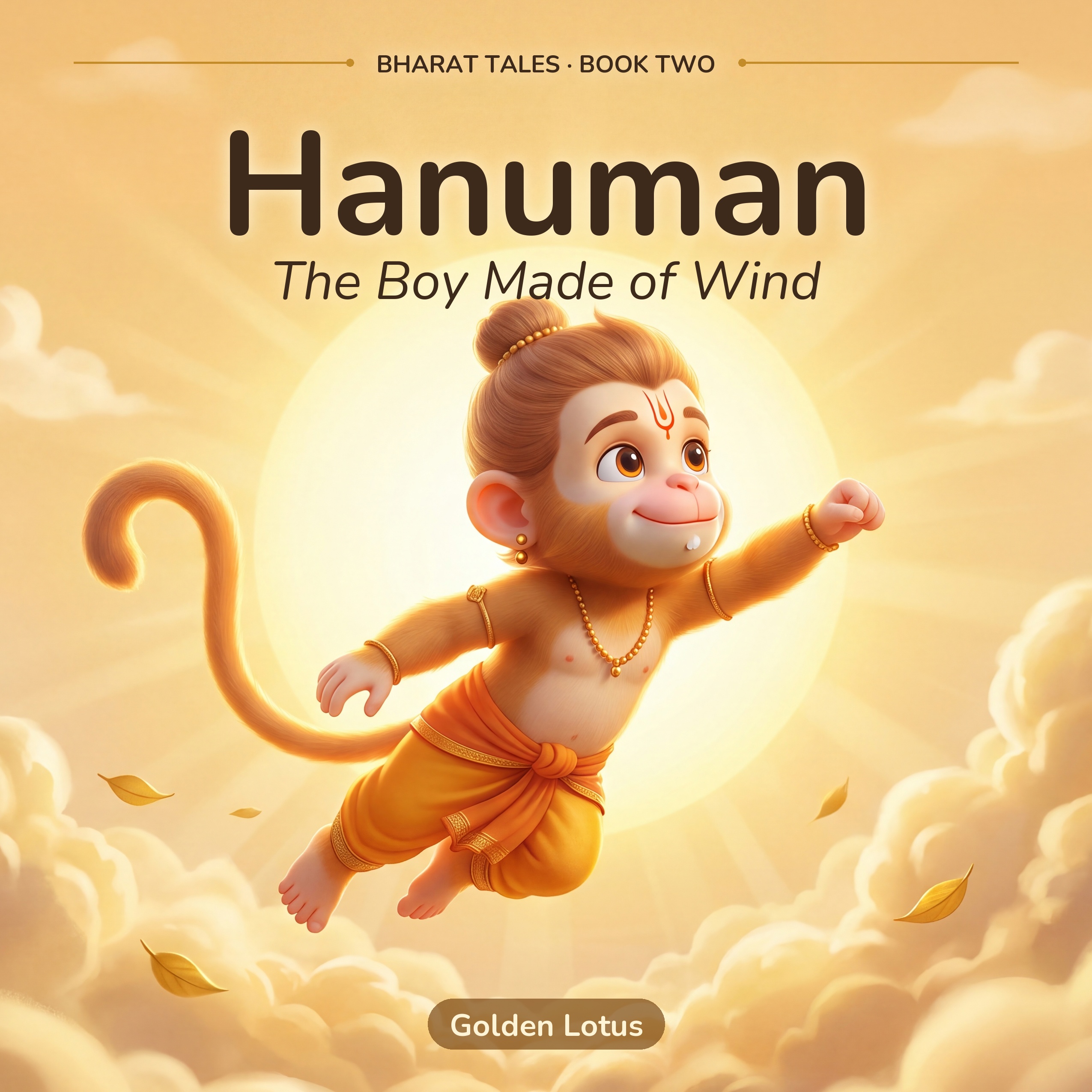
The story of the boy born of the wind, his leap toward the sun, and the teacher who showed him what his strength was for. Full colour. Ages 6–12.
Why these books exist
It isn't that they aren't interested. Nobody has handed them these stories in a form that fits the life they're actually living — in English, in books that look as good as everything else on their shelf, without a lecture attached.
Most Indian mythology books for children fall into one of two traps. Either they're printed cheaply and read like a school textbook, or they're simplified until the tradition has been sanded off entirely. A grandmother in Pune would not recognise the gods inside them.
Bharat Tales was built the other way around: checked against the source texts first, then made beautiful, then made simple. In that order.
Book One
Inside the book
Each chapter takes about four minutes to read aloud and ends with one small idea, offered as a gift rather than a lesson. One Sanskrit word is woven into every story and explained as it appears.
Parvati shapes a child from golden paste, and he stands guard at her door against someone far more powerful.
He returns changed, and the thing that makes him look different turns out to be the thing that makes him beloved.
A race against his swift brother, won not by speed but by seeing the question differently.
His pen breaks halfway through the Mahabharata. He does not stop, and he does not make excuses.
He tumbles, laughs at himself, and teaches the Moon what it costs to mock somebody.
Why families across the world speak his name before anything new begins — including your child's next hard thing.
✦
Read it before you buy it
Nothing withheld and no email required. If the voice is right for your child, the other five are the same.
Chapter One
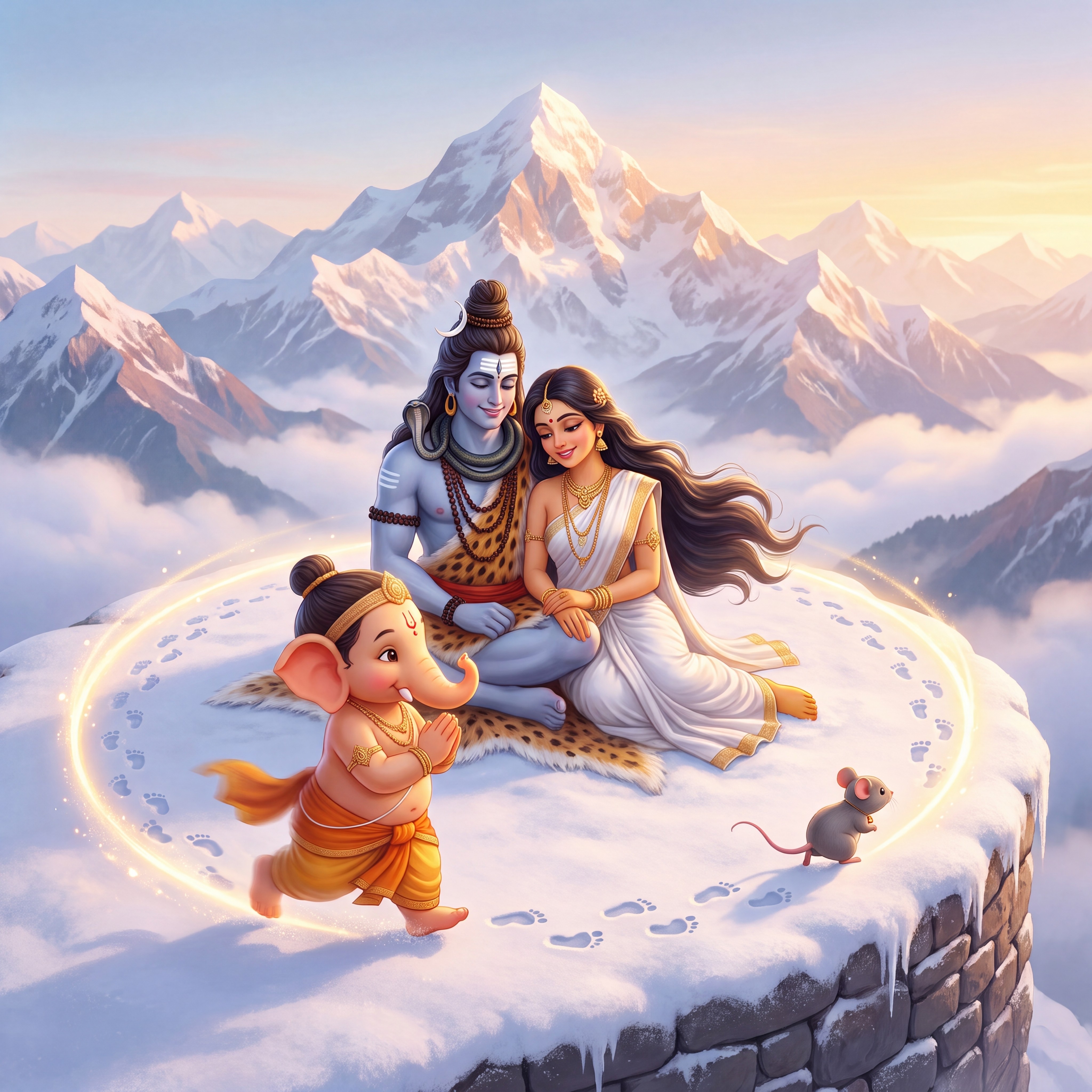
High on Mount Kailash, where the snow touches the sky, lived the goddess Parvati. Her husband, the great Shiva, had gone deep into the mountains to meditate, still as stone. The days were quiet. Parvati wished, more than anything, for a companion of her very own.
So she did something only a goddess could do. She gathered the soft golden paste from her own skin, and with her hands she shaped a little boy — small ears, round cheeks, bright eyes. Then she breathed her love into him. The boy opened his eyes, looked up, and smiled. “Mother,” he said. He was made of nothing but her love.
“I must bathe in the river,” Parvati told him. “Stand at the door, my brave one, and let no one pass.” The boy stood tall and proud. This was his very first task, and he would not fail it. Soon a powerful stranger came striding up the mountain and reached for the door. “None may pass,” said the boy, planting his feet. “My mother is inside.” He did not know the stranger was Shiva. And Shiva did not know this was his son.
Neither would step aside. There was a great clash on the mountaintop — and then, in a single moment, everything went quiet. When Parvati came out and understood what had happened, her cry shook the snow from the peaks. Shiva’s heart broke too. He had not known. Two who belonged to each other had met as strangers.
“I will make this right,” Shiva promised her. “I give you my word.” And he set off to do something no one had ever done before.
The boy was small, but he was brave. He stood up for what his mother asked of him, even before someone far more powerful than he was. Doing the right thing doesn’t wait until you feel big enough. You can be brave at any size.
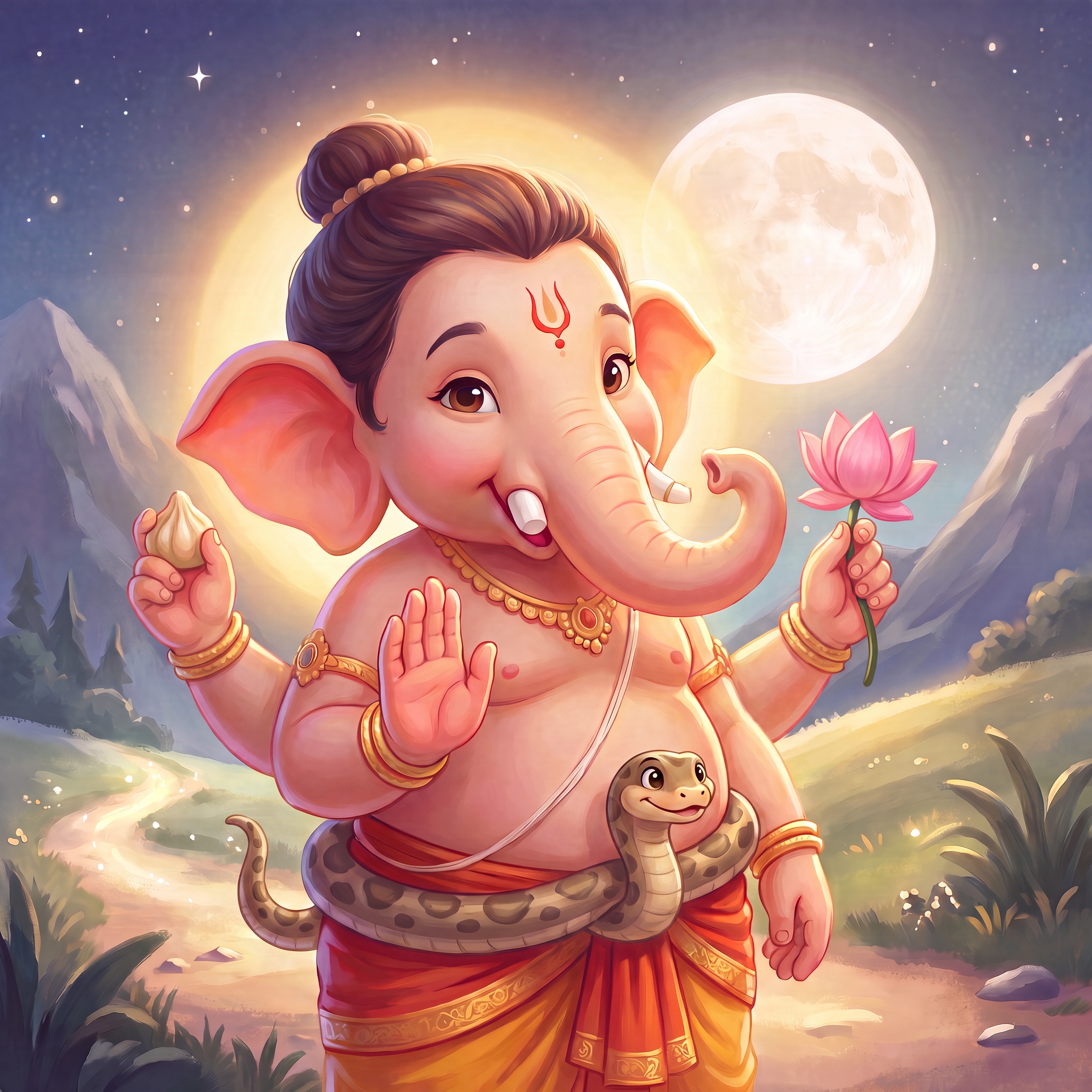
What your child keeps — Ganesha
The stories are the vehicle. These are the cargo.
✦
Book Two
Son of Vayu, the wind itself. A child so strong and so hungry that one morning he leapt straight at the sun, mistaking it for a fruit — and found out, the hard way, what that kind of strength is actually for.
Coming very soon
Arriving on Amazon within days. Same promise as Book One: checked against the source texts, drawn with the iconography held exactly, and gentle where the myth asks for gentleness — without losing the weight of the moment that makes it worth telling.
Inside the book
From a restless baby to the leap across the ocean to Lanka — the whole arc, each chapter closing with its own seed to carry.
Son of Vayu, born stronger and hungrier than any child should be.
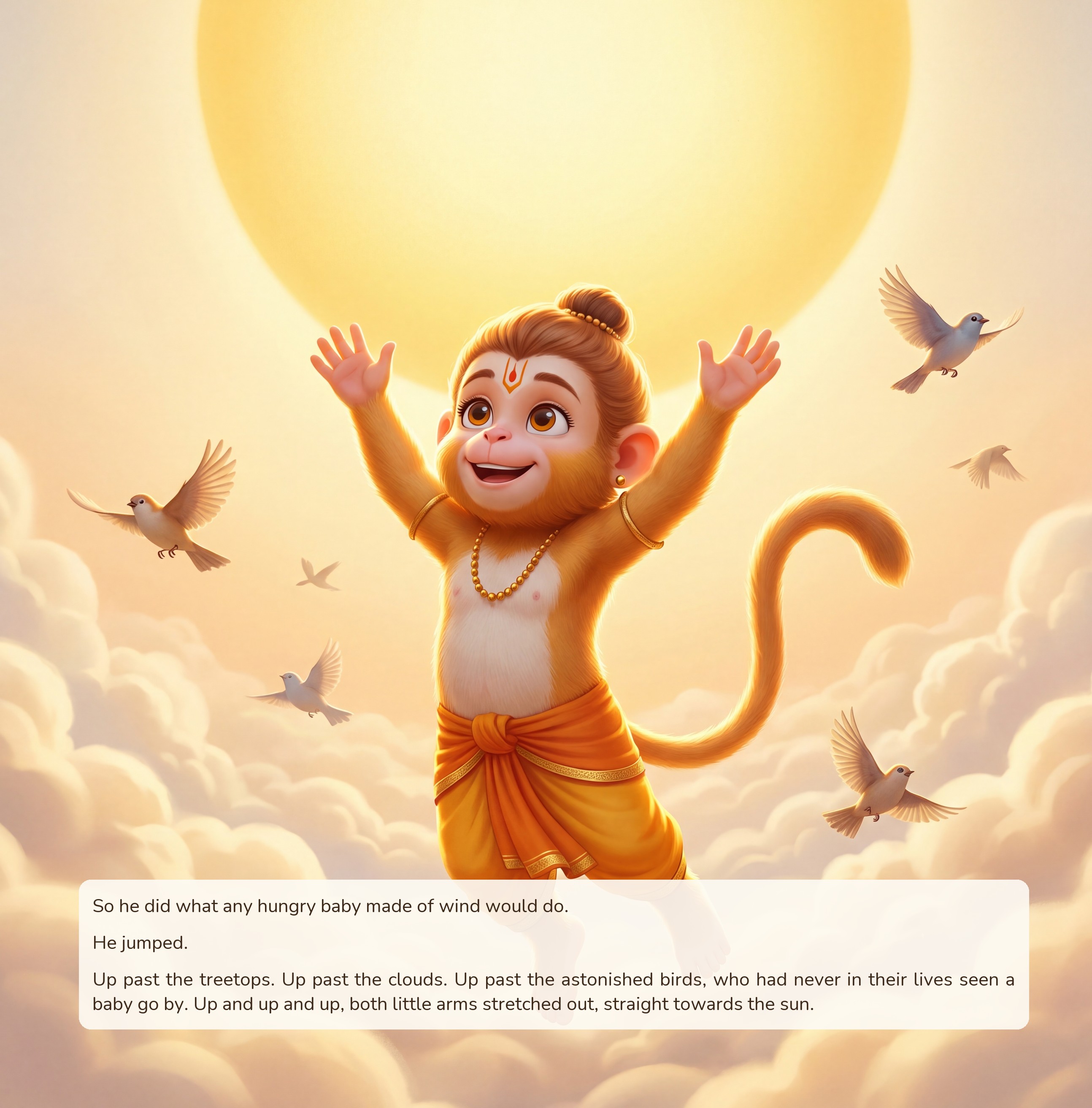
He mistakes the rising sun for a mango, hanging low enough to eat — and leaps.
His own strength gets the better of him, and the sages who love him give him a lesson he won't remember until the day he needs it most.
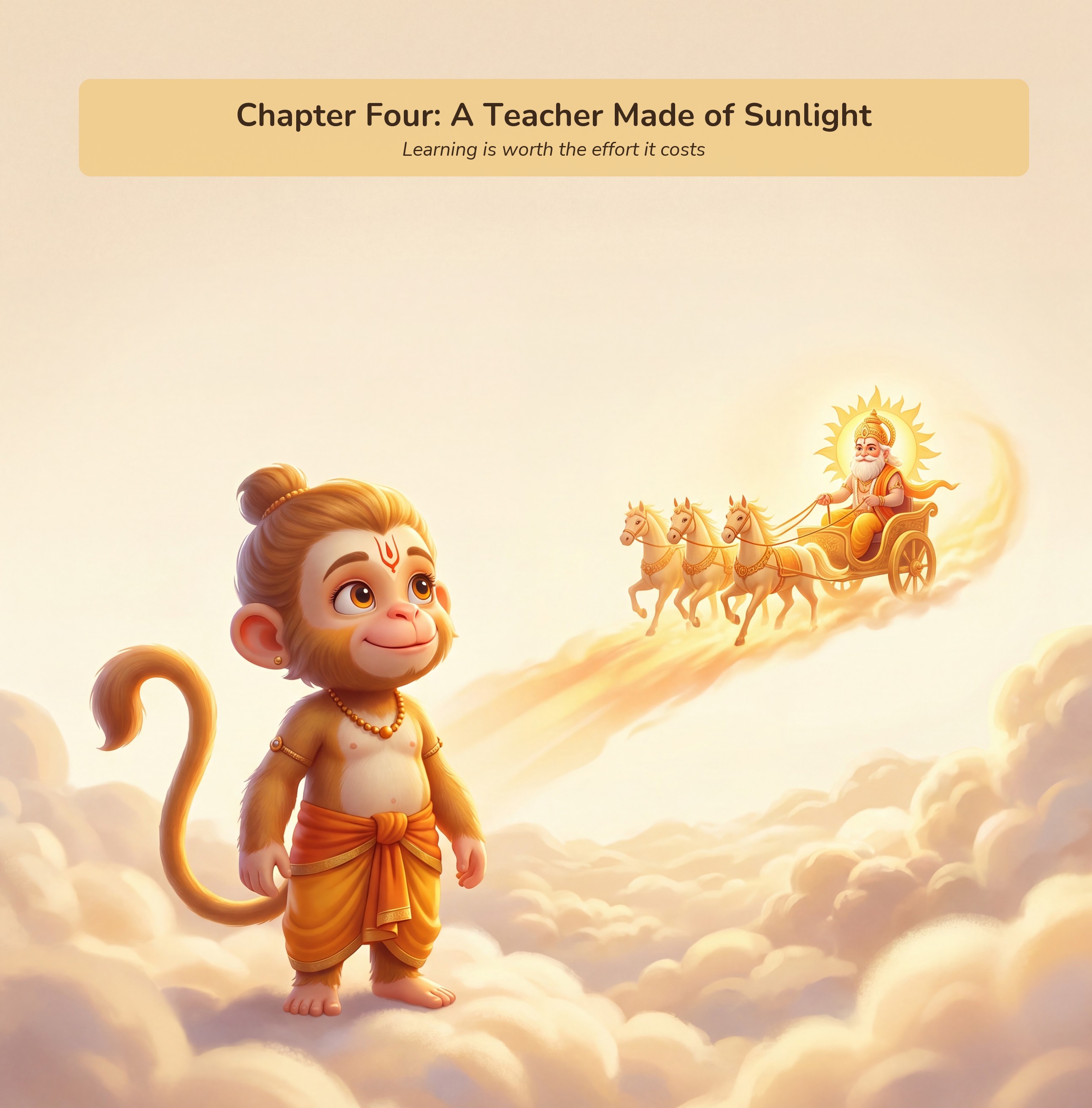
Surya himself becomes his teacher, and shows him what effort is actually for.
A meeting in the forest that becomes the reason for everything that follows.
Before the hardest leap of his life, an old friend reminds him of something he'd forgotten about himself.
Alone in enemy territory, he finds what he came for and gives it to someone who needed to know she hadn't been forgotten.
Unable to tell one healing herb from another, he doesn't waste time worrying about which one — he brings the whole mountain.
What your child keeps — Hanuman
How it's made
The same discipline runs across every Bharat Tales book.
Every chapter traces to a real text — the Puranas, the Ramayana tradition, the Mahabharata. Nothing is altered to make it easier to sell abroad.
Ganesha's single tusk, broken from the fourth chapter on. Hanuman's mace and the sacred thread over the left shoulder. Details families recognise, kept consistent on every page.
The frightening moments happen quietly, off the page, without losing what makes them matter. A six-year-old can hold these stories safely. They're written so they could.
Before you buy
No. The hardest moment in the Ganesha story happens off the page, in a single quiet line, and the chapter resolves warmly before it ends. Younger children meet it the way they meet any fairy tale — with curiosity rather than fear. Read Chapter One above and you'll see exactly how it's handled.
There's a real moment of danger — he's struck down on his leap toward the sun. It's told with care and resolved with warmth: his father's grief, and the gods' response to it, is what gives Hanuman the blessings he's known for. We kept the weight of that moment rather than softening it away, because it's the reason the rest of the story means anything — but nothing is drawn or described in a way that would frighten a six-year-old.
Yes. It's written entirely in English. One Sanskrit word appears in each story and is explained in the sentence right after it, and there's a small glossary at the back. That's the whole language load — a handful of words across each book.
About four minutes aloud. Each book is built for one chapter a night across a week, or the whole thing in one rainy afternoon.
It's cultural, and it's reverent. There's no instruction in ritual or worship — these are the stories themselves, told accurately, with the values inside them left to do their own quiet work. Families who aren't practising read them happily.
Yes. Ganesha was first, Hanuman is next, and more of the Bharat Tales series are already planned. Join the list and you'll know the moment each one arrives.
Amazon prints and ships locally in Australia, the US, the UK and Canada, so postage is ordinary domestic postage wherever you are.
Bharat Tales
One short email when Hanuman — and every future Bharat Tales book — is ready. Nothing else, and nothing passed to anyone.
Opens your mail app, addressed to hello@goldenlotusbooks.com. Nothing else needed.
Groups
Running a festival event, a Sunday culture class, a bal vihar group, or a school library order? Bulk copies and read-aloud sessions can be arranged across the series — in person around Sydney, online anywhere.
Email about a group orderStories your child will actually sit still for, and ideas they'll carry a good deal longer than that.